
Are Heelys Safe? A Parent's Guide to Roller Shoes
Few things cause a parent more quiet dread than a child gliding across a supermarket floor in a pair of trainers. Roller shoes, better known by the brand name Heelys, have been a playground fixture for more than two decades, and the question we hear most often at the counter is a simple one: are they actually safe? The honest answer is that they are about as safe as the sense you bring to them. A child who understands how they work, where to use them and what to put on first is at very low risk. A child who treats them like ordinary shoes on a staircase is not.
This is a guide for the grown-up making the decision, not a how-to for the rider. If your child already has a pair and wants to learn the actual technique, our step-by-step guide to using Heelys covers balance, starting and stopping in detail. Here we are answering the questions that come before that: how they work, what age they suit, and how to tilt the odds firmly towards a fun first season rather than a trip to A&E.
How do Heelys actually work?
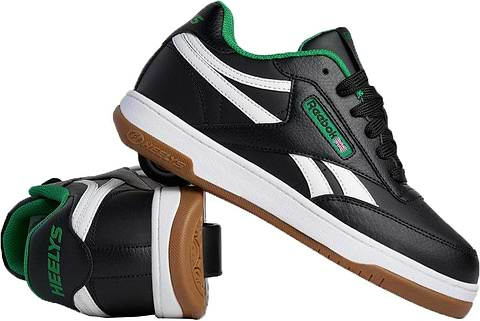
A roller shoe is a normal trainer with a single difference: a small wheel (or two) set into a recess in the heel. When the wearer walks, their weight sits on the sole and the shoe behaves like any other. To roll, they shift their weight back and lift the toes, so they are balancing on the heel wheel and gliding. Drop the toes again and they are walking. That is the whole trick, and it is why Heelys feel so sudden to a newcomer: the switch between walking and skating happens in a fraction of a second.
Crucially, the wheel is removable. Most models ship with a tool so the wheel can be popped out, turning the shoe back into an ordinary trainer. This matters more than it sounds, and we will come back to it, because taking the wheel out is one of the simplest safety habits a family can build.
One wheel or two?
You will see both. Single-wheel models are the classic Heelys design: faster, more manoeuvrable and the choice of most children who get properly into it. Two-wheel roller shoes sit lower and more stable, which makes them far more forgiving for a first-timer or a younger child still finding their balance. If you are buying for a nervous beginner, the two-wheel style is the gentler place to start. A confident child who has skated or scootered before will usually be happier on a single wheel.
What age are Heelys for?
As a rough rule, children from around five can manage roller shoes, and that is the lower end of the sizing most brands offer. Age is less important than two other things: balance and attention. A child who can already ride a scooter or a bike without stabilisers has the balance for it. A child who will actually listen to "walk through the shop, don't roll" has the judgement for it. If one of those is missing, it is worth waiting a season rather than forcing it.
Fit matters as much as age. Roller shoes should fit like proper trainers, snug but not tight, because a loose heel is exactly where control is lost. It is tempting to size up and hope they last the year, but with roller shoes that is a false economy: the extra room goes straight into wobble.
So, are they safe?
The risks with roller shoes are real but predictable, which is the good news, because predictable risks are manageable ones. Almost every roller-shoe accident falls into one of three buckets: a backward fall onto the wrist or the back of the head, a collision because a child rolled somewhere crowded, or a tumble on a surface that was never suitable in the first place. None of those is mysterious, and all three can be designed out.
Gear up first
Because the classic roller-shoe fall is backwards, the two pieces of protection that earn their keep are a helmet and wrist guards. A well-fitting helmet should sit level and low on the forehead, not tipped back, and the strap should be snug enough that you cannot fit more than a finger or two underneath. Wrist guards matter because the instinct in any fall is to throw out a hand, and the wrist is the joint that pays for it. For a child who is still finding their feet, knee and elbow pads round out the set and give a cautious rider the confidence to commit rather than tensing up.
The right ground, and the wrong ground
Roller shoes belong on flat, smooth, dry surfaces with room to spare. Smooth concrete, an empty playground, a quiet pavement: all fine. The places to avoid are the ones that cause most of the trouble. Steer clear of hills, because a heel wheel has no brake and gravity does not negotiate. Avoid rough or rocky ground and anything with kerbs, where a tiny wheel catches and stops dead while the child does not. And keep away from crowds and traffic entirely, which is the single rule that prevents the nastiest collisions.
One surface deserves a special mention: the home. A child in skate mode on a kitchen floor or, worse, near the stairs is a fall waiting to happen, and often one that takes a parent or sibling down too. This is where the removable wheel earns its place. Making it a house habit that the wheels come out indoors means the shoes simply cannot be used where they are most dangerous, and it stops that heel-forward walk that encourages kids to roll without thinking.
Learn to stop before anything else
If there is one skill worth insisting on before a child rolls anywhere public, it is stopping. A rider who can reliably slow and stop, usually by lowering the toe or stepping off, is a rider in control. Supervise the first few sessions on open flat ground, and do not let the shoes out in public until stopping is second nature. That one rule prevents more scrapes than any pad.
Are Heelys worth it?
For the right child, roller shoes are a genuinely brilliant bit of kit: active, sociable, endlessly practised in the back garden, and a surprisingly good gateway into scooters and skateboards, because the balance they build carries straight across. They make an excellent gift for exactly that reason, and a helmet and wrist guards alongside them turn a slightly nervous "are these safe?" into a confident yes.
Treated as a toy you can wear anywhere, roller shoes will eventually catch a child out. Treated as a piece of skate kit, with the gear, the sensible ground and the stopping drilled in first, they are a low-risk, high-fun way to spend a childhood summer. The safety, in the end, is not in the shoe. It is in the habits you build around it.


