
How to Drop In on a Skateboard
There is a particular silence that falls over a skatepark when someone stands at the top of a ramp for the first time, tail hanging over the coping, trying to make their feet do the thing their brain is screaming against. Learning to drop in is the moment skateboarding changes gear. Up to that point you have been pushing, turning and maybe learning to ride your complete skateboard comfortably on flat ground. Dropping in is the door into ramps, bowls and the whole world of transition skating, and almost everybody finds it terrifying the first time.
The good news is that it is far more about nerve than about talent. Get the technique clear in your head, pick the right ramp and commit properly, and most people land their first drop in a single session. Here is how to do it, and how to stop the fear from throwing you off.
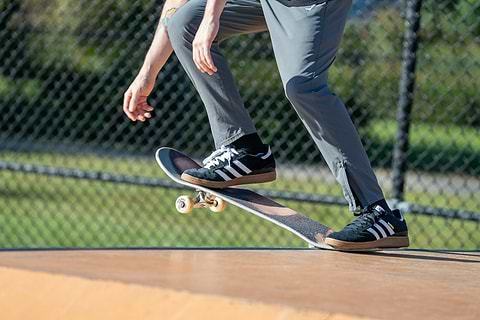
Is dropping in on a skateboard hard?
Physically, no. The movement itself is simple: you lean forward, your front wheels touch the ramp and gravity does the rest. Mentally, it is one of the biggest hurdles in the sport, which is why so many riders ask whether dropping in is the hardest thing in skateboarding. It is not technically the hardest trick, not by a long way, but it may be the hardest thing to convince yourself to do, because every instinct you have tells you to lean back and away from the slope. That instinct is exactly what makes people fall. Beating it is the whole skill.
So treat dropping in as a confidence exercise with a bit of body position attached, rather than a trick you need to be strong or gifted to pull off.
Gear up before you go anywhere near the coping
This is not the section to skim. When a drop-in goes wrong it tends to go wrong fast, with your knees and wrists heading for the flat bottom of the ramp. A decent helmet is non-negotiable (most skateparks insist on one anyway), and a set of knee and elbow pads changes everything about how willing you are to commit. That is the quiet secret of transition skating: good pads do not just protect you, they give you permission to try. If you know a slam will slide harmlessly down the ramp on your kneepads, you stop hesitating, and hesitation is the real enemy here. Plenty of park riders rate a proper dedicated set of knee pads as the best purchase they made when learning ramps.
Start on the right ramp
Do not learn on the biggest quarter pipe in the park. Find a small, mellow ramp, ideally somewhere between knee and waist height with a gentle transition. A low ramp lowers the stakes without changing the technique one bit, so everything you learn transfers straight up to bigger walls later. If you are lucky enough to have space at home, a small mini ramp of your own is the fastest way to get the repetitions in, because confidence on ramps is built through sheer volume of attempts, not through big single leaps.
Before you even roll, practise the stationary position. Rest your tail on the coping with the back truck hooked over the edge, place your back foot firmly on the tail and hold the board flat and level. Get used to standing there balanced. Half the battle is being comfortable in that pose.
How do you drop in on a skateboard, step by step
With your tail resting on the coping and your weight back, here is the sequence:
- Back foot first. Plant your back foot squarely on the tail, over the bolts, to hold the board still on the edge.
- Front foot over the front bolts. Place your front foot across the nose, directly over the front truck. This is the foot that decides everything.
- Shoulders square and chin up. Line your shoulders up with the board and look down into the ramp, not at your feet.
- Commit your weight forward. In one decisive movement, press down through that front foot and lean your chest and shoulders forward so the front wheels slam onto the transition. Do not ease into it. The faster you commit, the easier it is.
- Stay over the board. As the wheels bite and you roll down the ramp, keep your weight centred over your feet and ride it out, knees soft.
That is genuinely it. The entire trick lives in that forward commitment. If your front wheels are planted and your weight is over them, you roll in cleanly. If you hold back, the board shoots out in front of you. There is almost no middle ground, which is why "just send it" is the most common advice you will hear at any park, and why it is actually correct.
The one mistake everyone makes
Leaning back. Every single time a beginner's board slips out from under them, it is because fear pulled their weight away from the ramp at the last second. On a ramp that is precisely the wrong move. A useful mental trick is to tell yourself to put your front shoulder down towards the flat bottom as you go. Overdoing the forward commitment feels wrong but works; underdoing it feels safe and fails.
If the full drop is too much at first, roll up and down the transition without dropping in, so your body learns that the ramp is grippy and predictable. Then try a low drop-in on the smallest ramp you can find. Each clean one rewires the fear a little more.
Taking it to a mini ramp or bowl
Once a small quarter pipe feels routine, a mini ramp is the natural next step, using exactly the same technique with a bit more speed. A bowl is similar again, though the curved walls mean you should pick a lower section of the lip to start from and look across the bowl rather than straight down. If you ride a park regularly, getting a feel for the flow of park and transition riding helps you read where to drop in and where to carry your speed afterwards.
And what about an acid drop?
You will hear the term thrown around, so it is worth clearing up. An acid drop is not the same thing as dropping in. Dropping in starts with your tail on the coping; an acid drop means riding off the end of a ledge or ramp with no tail contact at all and landing on the flat or transition below, essentially a free fall onto your wheels. It is a later, more advanced move, and learning a solid, committed drop-in first gives you the body position you will rely on when you get there.
A note for scooter riders
None of this is skateboard-only. Plenty of scooter riders learn to drop in on exactly the same ramps, and the principles carry across almost word for word: weight forward, commit the front end, look into the ramp, and let pads do the worrying for you. Whatever you ride, the ramp does not care how nervous you are. It only responds to where your weight is.
Stand at the top, put that front foot down over the bolts, and go. The fear shrinks the moment you stop arguing with it.


