
How to Roller Skate: A Beginner's Guide to Rolling, Stopping and Staying Upright
There is a moment every roller skater remembers: the first time the wheels roll and, instead of your feet shooting out from under you, you glide. Getting there is easier than it looks, because learning how to roller skate has almost nothing to do with natural talent and almost everything to do with a handful of small, sensible habits. Whether you have just bought your first pair or you are dusting off an old set, this guide takes you from clinging to the wall to rolling with confidence.
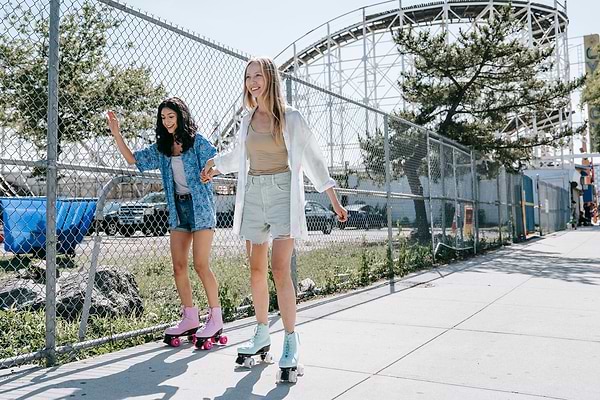
Why roller skating is worth learning
Roller skating has quietly become one of the most popular ways to move again. Rinks that stood half empty a decade ago are packed on a Friday night, roller discos have returned, and seafronts are full of people carving smooth lines. We wrote more about that comeback and why the rinks are full again, but the short version is this: skating is joyful, sociable and genuinely good for you, and it welcomes absolute beginners. You do not need to be young, sporty or fearless, just a bit of space, the right kit and a willingness to look slightly daft for an hour.
What you need before your first session
You need surprisingly little, but two things matter. The first is a pair of skates that fit properly. Most beginners start on quad roller skates, the classic four-wheel design with two wheels front and two back, because they give you a wide, stable base while you learn to balance. (If you fancy longer distances on smooth paths, inline skates line the wheels up in a single row and roll a little faster, though they ask more of your balance early on.) A skate that is too big slides your foot around and robs you of control, so follow a proper sizing guide rather than guessing.
The second thing that matters is protection, and it is not just for children. A helmet and pads (wrist guards especially, since your hands instinctively go down first in a fall) will turn most tumbles into a shrug rather than a trip to A&E. Wrist guards are the single best purchase a nervous beginner can make, because knowing your hands are protected lets you relax, and relaxed skaters fall less.
How to roller skate for beginners: finding your feet
Start off the wheels, not on them. Put your skates on somewhere carpeted or grassy and simply stand up, feet shoulder-width apart, getting used to the height and the wobble before anything rolls.
When you move to a smooth, flat surface, remember one word: bend. Almost everything about balance on skates comes back to a soft bend in the knees and ankles, with your weight forward over your toes rather than back on your heels. If you feel yourself tipping backwards, you are standing too straight, picture sitting down into an invisible chair.
Your first movement should be a march, not a stride. Standing still, lift one skate a couple of centimetres, put it down, then the other. Marching on the spot teaches your body that the ground can move and you will not fall. Once it feels natural, let each step drift forward and push gently out to the side, and you will start to roll. Congratulations: you are skating. Keep your arms out for balance, look ahead rather than down at your feet, and take small pushes rather than big lunges.
How to stop on roller skates
This is the part everyone worries about, and rightly so. Knowing how to stop on roller skates separates a fun session from a scary one, so learn it early, before you build up any real speed.
On quad skates you have a toe stop, the rubber block at the front of each boot. The simplest beginner method is the toe stop drag: roll slowly, let one skate trail behind you, and gently press the toe stop onto the ground like a brake. Keep your weight over the front foot and do not stamp.
The other beginner-friendly option, and the one that works on inline skates too, is the plough stop (sometimes called a snowplough, just like on skis). While rolling, push both heels outward so your toes point towards each other, then press down and squeeze; the wider you push, the more you slow. Practise both at walking pace until stopping feels automatic, because the whole point of a good stop is that you can reach for it without thinking.
- Toe stop drag: best for quads, trail one foot and press the toe block down gently.
- Plough stop: works on quads and inlines, push heels out, toes in, and squeeze.
How to roller skate backwards
Once forwards feels steady, skating backwards is a brilliant next goal, and less frightening than it sounds. Start still with your knees bent, point your toes slightly inward, and push your feet out and back in a gentle wiggle, drawing a series of squashed letter C shapes on the floor. Keep your weight low and central, glance over your shoulder rather than twisting right round, and expect it to feel strange for a session or two before it clicks. Learning to roller skate backwards also quietly improves your forward skating, because it forces you to control your edges and trust your balance.
Is roller skating good exercise?
Very much so. Roller skating is a genuine aerobic workout that lifts your heart rate while staying low impact on the joints, which makes it kinder on the knees than running. It works your legs, glutes and core, and counts towards the moderate aerobic activity health guidance recommends across the week, yet it rarely feels like exercise. Disguised as an evening at the roller disco with friends, it keeps you going far longer than a treadmill ever would.
Where to skate and how to stay safe
Beginners want smooth, flat and quiet: an empty tennis court, a quiet promenade, or best of all a local roller rink, where the surface is built for skating and there is space to fall without an audience. Avoid slopes until your stopping is reliable, steer clear of gravel and wet patches (water and skate bearings do not mix), and give pedestrians plenty of room.
If you are a parent buying for a child, the same rules apply in miniature: a properly fitting pair, a helmet and wrist guards from the start, and a calm, flat space for the first few wobbles. Children often learn faster than adults, being closer to the ground and less afraid of it.
The only real secret
Here is the thing no tutorial quite captures: everyone falls at the start, and it is completely fine. Learning how to roller skate is not about never falling, it is about falling well (bend your knees, aim for your pads, try to sit rather than reach) and getting straight back up. Give it three or four short sessions rather than one heroic afternoon, and one evening you will realise you have stopped thinking about your feet entirely. That is when the wheels start to feel like part of you.


