
The Rise of the Stunt Scooter: How a Toy Became a Sport
Stand at the edge of any British skatepark on a wet Sunday and listen. Under the rumble of skateboard wheels and the clack of BMX pegs there is a third sound now, a rapid metallic clatter of small wheels hitting concrete, over and over, as another rider rolls in to try a barspin. The stunt scooter has become as much a part of skatepark life as the board and the bike. What makes that remarkable is how recent it all is. Twenty-five years ago the scooter was a folding metal toy for getting to a friend's house, and nobody thought to take it any further. This is the story of how it grew up.
If you have only ever seen the modern stunt scooters that fill skateparks today, all welded decks and oversized bars, it is worth knowing where they came from, because the sport was quite literally invented by the kids riding it.
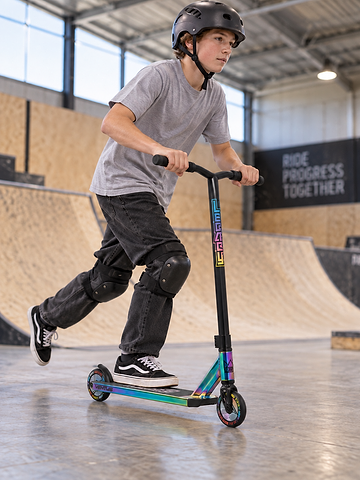
From pavement toy to skatepark fixture
The story starts in 1999, when Swiss inventor Wim Ouboter and his company Micro Mobility Systems created a lightweight folding aluminium kick scooter. Licensed and sold in the United States as the Razor, it became a genuine craze almost overnight: Razor USA alone sold around five million scooters in 2000. For most people that was the whole story, a fun way to get around that lived in the garage within a year.
But a handful of riders, many of them already skateboarders or BMXers, looked at these things and saw something else. If you could ollie a board and jump a bike, why not a scooter? They started taking them to skateparks, hopping curbs and dropping in on ramps, and quickly discovered two things: it was enormous fun, and the flimsy toys they were riding could not take the punishment. Razor even put together the first team of sponsored scooter riders and released early videos, and a scene, tiny at first, began to form.
When riders started building their own
Necessity did the rest. Stock scooters snapped, bent and rattled apart under trick riding, so the community set about fixing them. An online forum called the Scooter Resource, founded in 2003, became the meeting point where riders across the world swapped ideas and parts. Out of that grassroots tinkering came the building blocks of the modern machine: stronger forks, one-piece T-bars and Y-bars in place of adjustable stems, metal-core wheels that did not disintegrate, and compression systems that kept everything tight. The real turning point came in 2009, when the first one-piece welded deck arrived and the "toy" finally became a purpose-built piece of sports equipment.
With demand growing, dedicated brands stepped in to build scooters and parts properly, names like Madd Gear (MGP) and Blunt Envy that riders still argue over today. It also gave rise to one of the sport's defining habits: building a custom setup from individual decks, bars and wheels rather than riding whatever came in the box, so that no two scooters at the park are quite the same.
A real sport, with real pros
Once the kit could keep up, the riding exploded. The first proper scooter competition was held in Montreux, Switzerland, in 2005, and the discipline organised itself from there. The International Scooter Association ran the first Scooter World Championships in 2012, and the sport now has established park and street categories, with a women's park division added from 2019.
It has produced genuine stars, too. The American rider Dakota Schuetz, universally known as "Kota", won the first three World Championships from 2012 to 2014 and became the face of the sport during its boom years, landing tricks like the 1080 that would have seemed absurd on a scooter a decade earlier. Riders such as Ryan Williams carried it to a wider audience through the Nitro Circus tours, pulling world-first tricks in front of huge crowds. What began as kids messing about on toys now has a professional circuit, filmed and judged and taken every bit as seriously as skateboarding or BMX.
Why it stuck
Plenty of fads burn out. The stunt scooter did not, and the reasons say a lot about why it works. It is approachable: a complete beginner can roll, balance and get a first small hop far faster than on a skateboard, which makes those early sessions rewarding rather than frustrating. It sits naturally alongside skating and BMX at the same parks, so there is always a scene to be part of. And there is no ceiling: the gap between a first bunny hop and a filmed tailwhip down a set of stairs is years of progression, which is exactly what keeps riders coming back.
Getting in on it today
The happy result of all this history is that a scooter you buy now is better than anything the early riders had to hack together. If the story has you tempted, either for yourself or a child who lives at the local park, our where to start guide covers choosing the right size and a sensible first complete. Whatever you ride, treat a helmet as part of the kit from day one, because the skatepark is no respecter of beginners.
So the next time you hear that fast metallic clatter rolling around a skatepark, you will know it is not just noise. It is the sound of a toy that refused to stay a toy, ridden by a generation who decided to turn it into a sport, and are still writing the tricklist as they go.


